Our History
Establishment of socio-economic research laboratory
The Socio-Economic Research Laboratory, the genesis of the Institute of Socio-Economic Research, was established as a research facility affiliated with the Faculty of Economics, Osaka University. This was due to the extraordinary efforts of Yasuma Takada, Dean of the Faculty of Economics, who was keenly aware of the need to develop an orthodox economic theory in the chaotic postwar period. Yasuma Takada was appointed as the first director and professor. Subsequently, the number of courses was expanded through donations from the Kansai Economic Federation and other sources.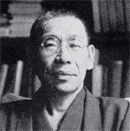
First issue of International Economic Review (IER)
First published by Michio Morishima of the Institute for Social and Economic Research and Lawrence R. Klein of the University of Pennsylvania. Initially published by the Kansai Economic Federation.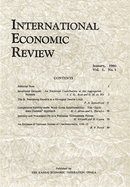
Renamed to Socio-Economic Research Facility
Transferred to the national government.Reorganize to institute of social and economic research, Osaka University.
The Institute of Social and Economic Research (ISER) joined Osaka University as the first institute dedicated to social sciences, in contrast to the three existing institutes focused on natural sciences: the Institute for Protein Research, the Institute of Industrial Science, and the Research Institute for Microbial Diseases.Reorganized into three major divisions: Theoretical Economics, Econometrics, and Economic Statistics
After several expansions of divisions, ISER was reorganized into three major divisions.Klein Lecture begins.
Honoring the work of Dr. Lawrence R. Klein, winner of the 1980 Nobel Prize in Economics and founder of the International Economic Review.Moriguchi Prize for Best Paper Award begins.
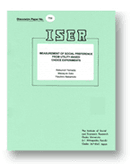
Based on a donation from Professor Emeritus Chikashi Moriguchi of Osaka University, the ISER Moriguchi Prize was established to encourage graduate student research in the field of economics.ISER Discussion Paper
PC Lab begins operations.
The PC lab is used for data analysis exercises based on economic experiments and econometric methods in experimental economics. Initially, 20 laptop computers were installed in an area of 72 square meters.Survey on "Consumer Preferences and Satisfaction" begins.
The study was initiated with the main objective of determining the magnitude of four parameters of the utility function: time preference, risk aversion, habit formation, and externality, and the data were published. Although the survey was discontinued with the 2024 survey, it has been used in many papers.Reorganized into three major divisions: theoretical economics, empirical economics, and policy studies / Research Center for Behavioral Economics (RCBE) established.
The Research Center for Behavioral Economics (RCBE) is established as the first center for behavioral economics research in Japan.Designated as a Joint Usage/Collaborative Research Center
As a core center for behavioral economics research in Japan, we share cutting-edge research methods in behavioral economics with Japanese researchers, conduct joint research, and make recommendations for the design of Japan's socioeconomic systems and economic policies.

Institute of Social and Economic Research
The University of Osaka
6-1 Mihogaoka, Ibaraki, Osaka 567-0047, Japan
©2026 Institute of Social and Economic Research, The University of Osaka・Photo by Shinya Yamada